
Showing posts with label RUSSIA. Show all posts

Saturday, September 26, 2009

Fruits of Our Labors: Squeezing Iran

Current analysis would indicate that the critics were right when they criticized Obama's scrapping of the Euro missile shield, saying it would embolden Russia. In diplomacy, just like in business or any other profession that involves trading or negotiating, all parties have a vested interest in eliciting concessions from the other side while minimizing concessions of their own, especially when it comes to major issues or national interests. The main reason to not make concessions when it comes to one's national interests (in the case of the Euro missile shield, national security) is literal: conceding on one's national interests weakens one's soft and hard power. The secondary reason, having perhaps an even more significant impact, is the fact that making concessions weakens one side's bargaining power and gives opposing sides the perception that the one side is willing to back down, thereby opening the door to aggression by opponents.
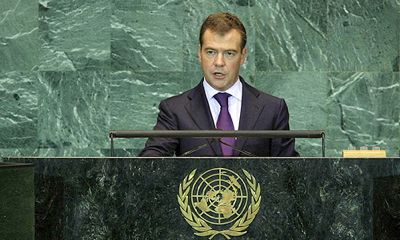
However, what often goes unnoticed is that there are two different types of diplomacy: public and private. There is what we as citizens and information consumers see and there is what actually goes on between nations. Simply put, what we read in the news paper and what policy think tanks put out is based on official accounts released by governments and close analysis of news sources. That account isn't always the whole story. When it comes to the relationship between the US and Russia, what we get in the news is rarely the whole story. If you read between the lines, you can begin to see that the current situation over the Euro missile shield isn't exactly how it appears.

When Obama chose to scrap the Euro missile shield, he did compromise on one aspect of our national security. However, the Euro missile shield was a good example of why pursuit of absolute security is in fact counter productive as it was pushing our relationship with Russia to the brink and possibly putting us on the path to a military confrontation. Nixing the Euro missile shield helped our diplomatic position with Russia, giving us a boost in relations and giving us credit with Medvedev. The effects of this concession can be clearly seen in the debate over Iran's nuclear program, a program which would not exist without Russia's assistance. Earlier this month, Russia wholly opposed new sanctions on Iran. Following Obama's scrapping of the Euro missile shield, Russia did a u-turn and now will support new sanctions on Iran while praising Obama's move in the same breath.

With Russia's help, the US is turning up the heat diplomatically on Iran and they are starting to squirm. The first piece of evidence is that Iran spontaneously admitted to the existence of a secret nuclear facility that, by all reports, is still under construction. Of course, Israel wasted no time in declaring this facility a nuclear weapons factory. Iran continued to backpedal, saying that they would allow the International Atomic Energy Agency (IAEA) to inspect the newly revealed nuclear facility in the hopes that they could beat back accusations that they are violating IAEA regulations. But, their efforts aren't working. The new revelation simply gives the US and international opposition more ammunition in their push for new sanctions. While China is still blocking new sanctions, Russia's change of heart is providing the US with key support that enables us to put the screws to Iran. Remember, Russia is currently the sole source of nuclear fuel to Iran.

The gut check here is fortuitous. Obama's first major diplomatic move is proving effective despite what the critics are saying. He is re-dedicating the US to the diplomatic process and it is paying off. However, the next twelve months are key to testing whether new boosts in relations and new opportunities are utilized or squandered. While Obama's redoubled diplomatic efforts are currently working for Iran, Venezuela is fast becoming a new crisis right in our own backyard. But, now that Obama is heading up the UN Security Council, his re-dedication to diplomacy is going to be infinitely more effective as he now has a direct channel to world leaders and an international body that has the authority to authorize and enforce international actions. While the UN faltered, became stagnant, and even irrelevant under Bush, the UN will be reborn from the ashes under Obama. Hopefully Obama is just as effective at being a world leader as he is at public speaking.

Thursday, September 17, 2009

Moving Forward: Scrapping the Euro Shield

So far, Obama's critics have been criticizing him for talking massive amounts of change during the election and failing to follow through on his key word. Until today, Obama hadn't changed much in the field of foreign policy or diplomacy aside from his world tour to reassure world leaders that he had in fact won the election. Today, however, Obama made his first significant change in diplomacy and foreign policy by scrapping the Euro missile defense shield, a major point of friction between the US and Russia toward the end of the Bush administration.

The Euro missile defense shield was a plan developed under the second Bush administration that included radar and missile interceptor stations in Poland and the Czech Republic. Russia didn't receive this plan very well for a couple of reasons. First, the Bush administration made it extremely arbitrary. They sent then Secretary of State Condoleezza Rice to Russia on a couple of diplomatic visits to essentially inform Russia that the shield was going up rather than to consult with Russia. Second, the reasons that the Bush administration was giving for why the missile shield was needed were seen by the Russians to be invalid and even phony.

Russia didn't respond well to this "inform rather than engage" diplomacy. Russia perceives Eastern Europe to be within its sphere of influence and this missile shield to be a violation of the unwritten balance of power, essentially a form of encroachment by the West. They issued grievances to that end which were ignored. The Bush administration was holding fast to the argument that the missile shield was needed to shoot down any missiles that could be launched by terrorists even though no terrorist group to date had the capability of launching an ICBM. Russia perceived this argument as a smokescreen to the West's true goal of encroaching on Russia's sphere of influence. Putin even went so far as to call it the start of a new Cold War and threaten military action.

But, in his first major break from the Bush administration's style of diplomacy and foreign policy, Obama decided to scrap the Euro missile shield in the hopes that the beginning of a new Cold War would be averted. The gut check here is hopeful and optimistic. Since Obama is actually starting to engage the Russians in diplomacy and showing them that we're willing to make significant changes, he will more than likely succeed in resetting relations between the two countries and increase our soft power with Russia. There are those that already criticize this move by saying that scrapping the Euro shield will embolden Russia, and they're not necessarily wrong. However, Russia is already a resurgent power in the grand scheme of things, and we need to salvage relations between our two countries if we're going to be able to work with them on curbing the Iranian and recently announced Venezuelan nuclear programs. After all, we can't have Russia going around dispensing nuclear technology to countries we think might be trying to make a bomb.

Monday, September 14, 2009

Nuclear Proliferation: Venezuela

The newest arrival to the nuclear proliferation party is no longer trouble-making Iran.  After his recent meeting with Russian President Dmitry Medvedev, Venezuelan President Hugo Chavez has declared that his country will develop nuclear energy with Russian help.  Chavez directly addressed the immediate concern by saying that they're not looking to develop a bomb (like we believe him) so we shouldn't bother with them like we bother with Iran (like we're just going to let it happen).

If Chavez hadn't already been making so much trouble in Latin America / South America, this might have been unexpected.  The fact of the matter is that Chavez and Russia have been so close over the past several years, Russian media calls him "Russia's comrade-in-arms-and-oil."  However, nothing quite illustrates the relationship between the two countries like big numbers, specifically the $20 billion joint oil venture and the $2.2 billion credit for Russian weapons.  Both of those numbers come from deals struck during the same visit as the nuclear technology deal.

But, reading further into that arms deal may provide a bit of information that is relevant to the nuclear energy debate, specifically that Venezuela is buying rockets from Russia.  Chavez has been at the center of arms race controversy with his buying habits over the past several years.  While Chavez insists the military hardware he acquired from Russia is purely for defense, Colombia has to wonder.  Furthermore, one has to wonder if this deal was a form of deterrence for when Chavez breaks the nuclear energy deal to the press.  Whatever the reasons, Chavez can't actually think that breaking this kind of news now with Obama about to head up  the UN Security Council is going to go over well.

The gut check here is incredulous.  While it is believable that Russia is looking to expand their venture into the nuclear energy market, it is completely unbelievable that they haven't learned a single thing from their experiment with Iran.  Iranian nuclear energy hasn't gone smoothly to say the least.  There is an international governmental organization known as the International Atomic Energy Agency (IAEA) that determines who gets to play with nuclear materials.  Russia circumvented the IAEA on its deal with Iran, and look where that got them.  Russia is once again circumventing the IAEA on a nuclear deal, so they clearly didn't learn that lesson.  Now, Venezuela, of all countries, is the one country that could start a full blown arms race and potentially completely destabilize the entire region.  Assuming that this deal actually goes through, Russia is fast becoming a facilitator of nuclear proliferation, something the UN, the IAEA, and the US are committed to opposing.  This new deal with Venezuela, right in our backyard, promises to produce some political fireworks.

Thursday, July 23, 2009

Frozen Conflict

Today, Vice President Biden appeared in Tbilisi, Georgia both to revisit the conflict between Georgia and Russia and to implicitly and explicitly show where the US stands. Nearly one year ago, August 2008, it's the start of the Beijing Olympic Games. But, the headlines were dominated by another more sinister incident: "Beijing wow's world, Moscow rolls tanks." In what seemed to be entirely surreal and completely out of the blue to nearly everyone, Russia had utilized it's entire war machine to invade and devastate a country with a land mass ratio of 245:1 (Russia 17,075,200 sq/km : Georgia 69,700 sq/km). This incident, however unexpected, was clearly brewing if one had seen the warning signs.

The conflict between Russia and Georgia is what is known as a frozen conflict, a state of hostilities between two countries or groups of people that doesn't have much violence has the potential to explode into a full blown conflict. Georgia has been at odds with Russia since the break up of the Soviet Union because of it's close relations with the US. Russia doesn't like countries in its back yard and within its sphere of influence being allied with the US, especially when we're looking to make Georgia a NATO member.

But, there is another significant side to this situation. South Ossetia and Abkhazia are two provinces within Georgia as its boarders are currently defined that are classified as breakaway provinces, meaning they're trying to secede from Georgia and join the Russian Federation. Russia holds the position that these two regions should be able to determine their own status while Georgia is standing tall on a territorial integrity claim. Under the current system of international law, both arguments are completely valid. However, neither country appeared like it was going to let such an issue be decided by the UN or any of its arbitrating bodies.

The conflict exploded in August of 2008 when Georgian forces moved into the provinces, attempting to quell a violent uprising. Russia responded almost instantly with its full military might. The swiftness of the conflict surprised everyone except for those who saw the warning signs. In 2007, Georgia brought several accusations against Russia to the UN, attempting to attain some sort of offical recognition of Russia's official involvement in pushing South Ossetia and Abkhazia to the tipping point.

The accusations centered around three separate incidents in 2007. First was the killing of two Russians alleged to be military officers in Abkhazia; Georgia claimed that they were providing arms, logistics, and training to rebels in the region. Second was a claim that Russia had violated Georgia's air space by flying a Mig fighter jet over the boarder and dropping a bomb that failed to detonate; Georgia backed this claim up with radar tracking evidence. The third, and perhaps most publicized, accusation occurred in early 2008 when fighter jets shot down a Georgian Unmanned Aerial Vehical (UAV). This time there was nearly concrete evidence of Russian involvement. The camera on the UAV captured video evidence of the Mig jet's identity before it was shot down. Add that to the radar evidence that shows the Mig took off from Abkhazia and one has to wonder if Russia wasn't planning ahead for the conflict that occurred in August later that year.

At stake here is relations with one of our most important regional allies as well as our relations with Russia. It is important to note that Biden gained great foreign policy clout during the 60's and 70's by playing a major role as a senator in nuclear arms reduction treaty negotiations with the Soviet Union. Today, the symbolism of Biden's playing an active role in formulating and carrying out our foreign policy towards Russia is extremely significant. He's probably one of the only remaining actors within our government that can adequately address a crisis in relations with Russia.

That being said, the gut check here is simple and yet complex. We cannot alienate Georgia and leave them alone in the wake of such a devastating conflict, being that they are a close ally. At the same time, we cannot afford to make political moves that would distance ourselves from Russia for various reasons, including but not limited to their ever present veto threat in the UN Security Council. Our relationship with Russia is already reaching frigid status due to many moves made under the Bush administration, including our push for the European Missile Defense Shield, our "America's way or the highway" style of diplomacy, and the international destabilization caused by the Bush Doctrine of Pre-emption. While Obama/Biden's election did signify change (or so we thought), Russia is clearly very wary of accepting that our ways have changed so abruptly. However, Biden took a more objective stance and did a good job of explicitly showing that the US is committed to standing by its allies while still attempting to rebuild relations with Russia. He also implicitly signified that the US is not going to attempt to force a resolution to the conflict between Georgia and Russia by showing that we'd rather let Russia take the first step, something that Russia is bound to like whether they acknowledge that or not.